Every cohort I teach, there’s a moment when a newer doula lowers their voice and asks some version of the same question: “What do I do if a client wants to talk about medical aid in dying (MAiD) or death with dignity?” You can hear the nervousness in it. It sounds like a question about the law. It usually isn’t. It’s a question about whether they’re allowed to stay in the room for that conversation, whether it’s theirs to hold.
So let’s take the fear out of it the way we take the fear out of everything in this work: by saying the plain words out loud, in order, without hesitation. Here is what medical aid in dying actually is, where it’s legal right now, and what our job is (and isn’t) when it comes up.
Medical aid in dying (MAiD) is a legal end-of-life option in which a terminally ill, mentally capable adult with a prognosis of six months or less can ask a doctor for a prescription for medication that the person may choose to take themselves to die peacefully. The person must be able to self-administer the medication. As of mid-2026 it is authorized in 13 U.S. states and Washington, D.C.
What Medical Aid in Dying Actually Means
Medical aid in dying is a practice, and it’s also a legal framework. A person who is already dying (not a person in crisis, not a person who could be treated and get better) asks their physician for a prescription. Two clinicians confirm the diagnosis and the person’s ability to make the decision. After a set of requests and waiting periods, the person receives the medication. And then, crucially, the person decides. Many people who qualify and fill the prescription never take it at all. They keep it on the shelf as an option, and the option itself brings a kind of peace.
That last part is the part I most want new doulas to understand. This is not something done to a dying person. It is something a dying person may choose to do, in their own time, with their own hand. The control stays with them. That is the whole design.
The Words Matter: “Aid in Dying,” “Assisted Suicide,” or “Death with Dignity”?
You will hear several names for this, and as doulas we should be fluent in all of them, because our clients will use different ones.
Medical aid in dying (MAiD) is the term most clinicians and advocacy organizations now use, because it describes the practice plainly and without judgment.
Death with dignity is the name many of the actual statutes carry (Oregon, Washington, and others), so you’ll see it in the law itself.
Physician-assisted suicide / assisted suicide is older language still used in some coverage and in medical ethics debates. Many people in this field, and many who choose it, reject the word “suicide.” They point out that these are people who do not want to die but are dying already, and are choosing the manner of a death that is already coming.
I’m not here to police anyone’s vocabulary. But know the terms, notice which one your client reaches for, and follow their lead. Also notice your own vocabulary, your feelings, and your bias.
How Medical Aid in Dying Works: Who Qualifies
The details vary by state, and you should always read your own state’s statute rather than assume. But the authorized U.S. laws share a common backbone, modeled on Oregon’s. Generally, a person must:
Be an adult (18 or older);
Have a terminal illness with a prognosis of six months or less, confirmed by two physicians;
Be mentally capable of making and communicating their own health care decisions;
Make the request voluntarily, typically more than once, with both spoken and written requests and witnesses;
Be able to self-administer (take the medication themselves); and
Be a resident of the state, with two exceptions. Oregon and Vermont no longer enforce residency requirements, so qualifying non-residents may travel there for care.
Built into every one of these laws is a set of safeguards: waiting periods between requests, the two-physician confirmation, and the requirement that the person be able to change their mind at any point. New York’s law, for example, adds a recorded oral request and a mandatory mental-health evaluation. These steps take time, which is worth knowing when a client is already short on it. Setting the expectation that this is a medical protocol and the standards cannot be waived.
What Medical Aid in Dying Is Not
Half of doula work is clearing away what a word is not, so the family can see what it is. A few important distinctions:
It is not euthanasia. In euthanasia, a clinician administers the medication. That is illegal everywhere in the United States. In medical aid in dying, the person takes it themselves.
It is not the same as VSED. Voluntarily stopping eating and drinking (VSED) is a separate, legal path a person can choose without a prescription. Different route, different support.
It is not withdrawing treatment, and it is not hospice or palliative sedation. Declining a ventilator, stopping dialysis, or receiving medication to ease agitation at the very end are all distinct choices with their own frameworks.
When these blur together in a family’s mind (and they do), our job is to slow down and name which thing we’re actually talking about.
Where Is Medical Aid in Dying Legal in 2026?
As of mid-2026, medical aid in dying is authorized in 13 states and Washington, D.C. Montana is included because a 2009 state Supreme Court decision permits the practice, though Montana has no statutory program built around it. Three of these laws are brand new, and two of the newest are not yet in effect, an important detail if a client asks you today.
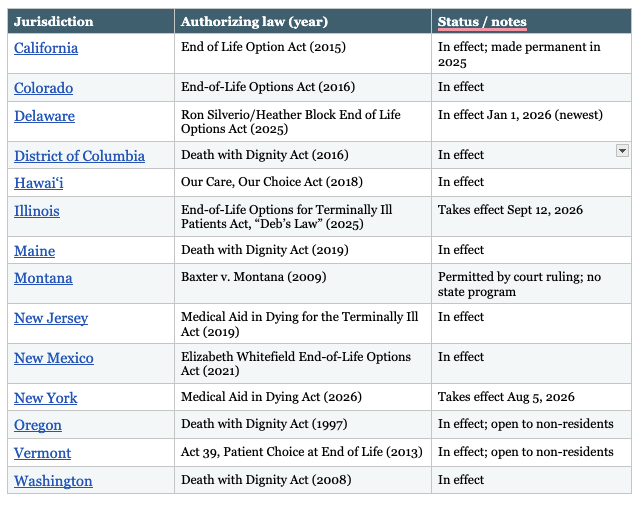
Two things to watch as a doula: effective dates and residency. New York’s law takes effect August 5, 2026 and Illinois’s takes effect September 12, 2026: enacted, but not yet usable by patients as of this writing. Delaware’s took effect January 1, 2026. And Oregon and Vermont are currently the only two jurisdictions open to qualifying people who live elsewhere.
Laws in this area change quickly. Always confirm the current status and the exact statutory text on the official source before you rely on it. The two nonpartisan trackers below keep continuously updated maps: Compassion & Choices and Death with Dignity.
The Death Doula’s Role: Presence, Not Prescriptions
Here is the line that settles most of the nervousness in my cohorts: medical aid in dying is a medical and legal process, and almost none of it is the doula’s job to carry out. We do not diagnose. We do not evaluate capacity. We do not prescribe, we do not obtain, and we absolutely do not administer the medication. By law, the person administers it themselves. Staying clearly on the non-medical side of that line is not a limitation. It is what keeps us useful and keeps us trusted.
So what do we actually do? A great deal, as it turns out.
We hold space without an agenda. A client needs one person in the room who is steady and grounded, will not lobby them toward it, and will not lobby them away from it. That neutrality is rare and it is precious.
We help them find the words. To ask their doctor. To tell their family. To say the true thing out loud without immediately cleaning it up for someone else’s comfort.
We help them navigate. We know the landscape (what the option is, what it isn’t, and who the qualified providers and organizations in the region are), so we can guide them toward resources they ask about.
We support the whole family. Some family members will be firmly opposed, and their fear can fill a house. Part of our work is making room for a range of feelings without letting any one of them override the dying person’s wishes.
We tend the space and the day itself. If a person chooses this path, there is often ritual, presence, and meaning to hold, the same work we bring to any bedside.
And we stay in our lane on purpose. Know your state’s law. Know the scope your certifying body sets for you. When a question is medical or legal, our best move is often the most powerful one we have: connect the person to the right professional, and then stay beside them while they walk through it.
How to Hold Space Without Steering
A client once told a colleague of mine that what she needed most was someone who wasn’t going to fall apart when she said the truth. That’s us. Whatever you personally believe about medical aid in dying (and you’re allowed to believe something), the person in the bed does not need your position. They need your company.
Your job is to be the steady one in the room: unshockable, and unwilling to look away. Presence matters more than perfection. If you can offer that, you can support someone through this conversation, whichever way they ultimately choose.
Learn to Do This Work: The Next Compass Doula Academy Cohort
If reading this made you lean in rather than pull back, if you found yourself thinking I want to be the steady person in that room, that instinct is worth following. Medical aid in dying is exactly the kind of terrain we prepare doulas for: the law, the language, the scope, and the presence it takes to hold it well.
My next Compass Doula Academy online cohort begins this August. It’s a live, small-group training for people who want to do this work with confidence and integrity.
Frequently Asked Questions About Medical Aid in Dying
Is medical aid in dying covered by insurance or Medicare?
Usually not for the medication itself. A 1997 federal law, the Assisted Suicide Funding Restriction Act, bars federal programs like Medicare and Medicaid from paying for aid-in-dying medication, so people often pay out of pocket. Coverage of related clinical visits varies by private insurer, and a few states handle it differently (New Mexico’s Medicaid, for example, reimburses for the medication). Hospice care and comfort-focused services, by contrast, are typically covered. Confirm specifics through your state program and Compassion & Choices’ coverage guidance.
Can a death doula be present when someone uses medical aid in dying?
Often, yes, if the dying person and family want you there. A doula’s presence at the bedside is non-medical: you hold space, tend the environment, support loved ones, and bear witness. You do not handle or administer the medication, which the person must take themselves. Always work within your state’s law and your certifying body’s scope of practice, and follow the family’s lead on who is in the room.
Do all doctors and hospices participate in medical aid in dying?
No. Participation is voluntary for clinicians, and some hospitals, hospices, and health systems (including many faith-based ones) decline to take part. A patient in an authorized state may still need to find a participating physician. This is one reason knowing your regional resources is such valuable doula knowledge: you can help a client find their way to a provider who will honor the request.
How is medical aid in dying different from hospice or palliative care?
They’re different tools, and they often coexist. Hospice and palliative care focus on comfort and quality of life for a serious illness; they neither hasten nor postpone death, and most people using medical aid in dying are enrolled in hospice at the same time. Medical aid in dying is a specific, legally defined option for a terminally ill person to end their life on their own terms. One is ongoing comfort care; the other is a distinct choice a qualifying person may or may not make.
Sources and Further Reading
This article links to official government and legislative sources and to nonpartisan trackers. It is general information for education, not legal or medical advice. Statutory text and legal status change. Confirm current law on the official state source before relying on it.
Compassion & Choices: States Where Medical Aid in Dying Is Authorized
Washington: Death with Dignity Act, RCW 70.245
California: End of Life Option Act (CA Dept. of Public Health) (Health & Safety Code §§ 443–443.22; made permanent by SB 403 in 2025)
Oregon: Death with Dignity Act (Oregon Health Authority) (ORS 127.800–127.897)
Delaware: Ron Silverio/Heather Block End of Life Options Act, HB 140
New York: Medical Aid in Dying Act, Senate Bill S138 (Governor’s announcement)
Illinois: End-of-Life Options for Terminally Ill Patients Act (SB 9)